
Historical Match Data Powers Exact Minute Betting in European Youth Championships
Youth European Championships generate detailed records that analysts examine to refine wagers placed on the precise minute when specific events occur, and these archives cover multiple editions of the Under-21 and Under-19 tournaments stretching back two decades. Teams from across the continent compete in group stages and knockout rounds where first goals, initial bookings, and substitutions follow recurring temporal patterns that historical datasets capture with increasing granularity.
Archive Sources and Their Structure
Match reports compiled by governing bodies include timestamps for every significant action, while supplementary video analysis from providers adds second-level accuracy to events such as throw-ins or goal kicks that often precede the first goal. European football federations maintain centralized databases that categorize matches by competition phase, venue, and team styles, allowing researchers to isolate variables like average time to first booking in matches involving high-pressing sides versus possession-oriented squads.
Data from the 2023 edition, for instance, showed that first yellow cards appeared between the 18th and 34th minutes in 62 percent of group-stage fixtures, a distribution that aligned closely with figures from the 2019 tournament yet diverged from earlier cycles when refereeing directives differed. Observers note that these longitudinal comparisons become particularly valuable ahead of cycles such as the one scheduled to reach its knockout phase in August 2026, because rule adjustments and squad compositions evolve between editions.
Application to Minute-Specific Wagering Markets
Betting operators structure markets around exact-minute outcomes for the first goal or first card, and historical archives supply the probability distributions that shape those odds. Analysts cross-reference past fixtures with current team news, such as the presence of aggressive midfielders or defensive setups prone to early fouls, then adjust baseline percentages derived from aggregate tournament data. A study conducted by researchers at KU Leuven examined 184 youth international matches and identified that substitutions cluster between the 62nd and 78th minutes in 71 percent of cases when teams trail by a single goal, information that directly informs related proposition bets.
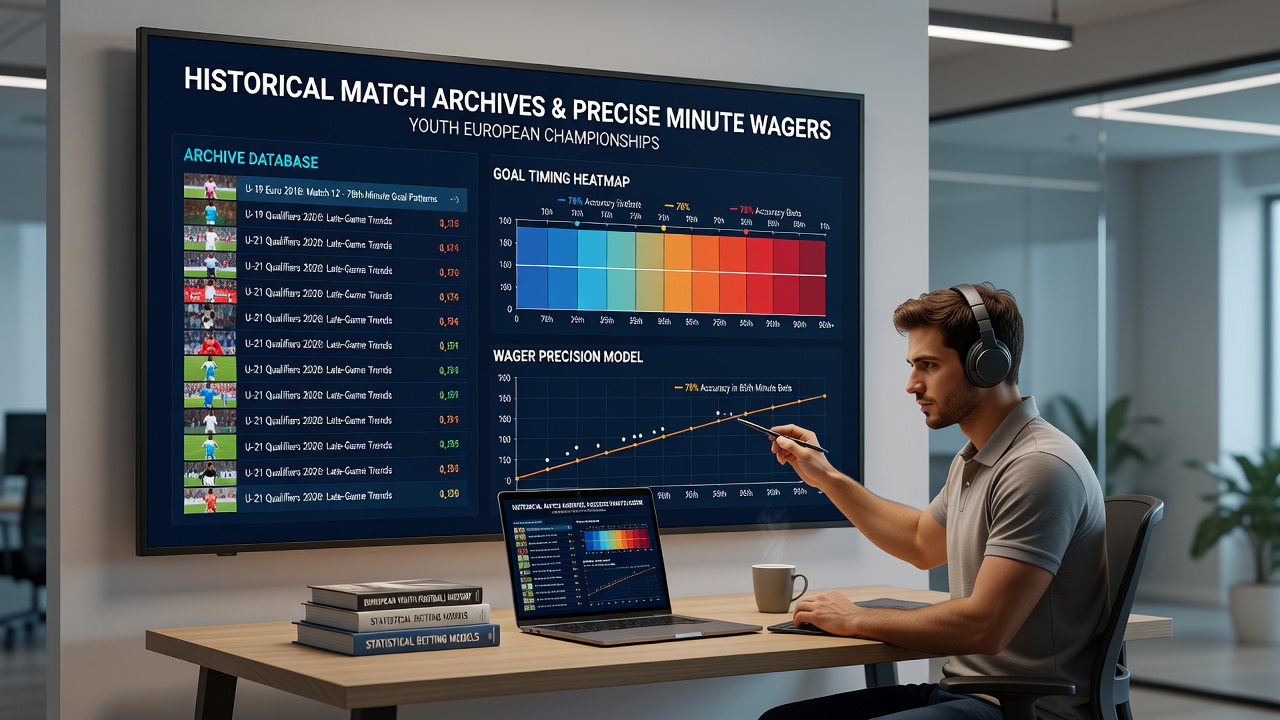
Those preparing wagers for the 2025 qualifying rounds already reference these same archives to model scenarios for August 2026 fixtures, where venue conditions and climate variations in host nations can shift event timing by several minutes on average. Weather records paired with historical timing data reveal that matches played in warmer evening slots produce later first goals compared with cooler afternoon kickoffs, a correlation quantified in reports from the Australian Institute of Sport that examined environmental impacts on junior football across multiple continents.
Statistical Methods and Pattern Recognition
Advanced filtering techniques separate matches by scoreline progression, allowing models to predict the minute range most likely to contain the opening goal once an early chance is squandered. Poisson distribution models calibrated on youth tournament datasets produce minute-by-minute probabilities that operators update in real time, while machine-learning approaches trained on the same archives detect interactions between variables such as red-card timing and subsequent goal moments that simpler averages overlook.
One analysis of Under-21 matches between 2015 and 2023 demonstrated that teams reduced to ten players concede their first goal after the dismissal in the 12-to-19-minute window 48 percent of the time, a finding that informs live betting adjustments during August 2026 group matches where disciplinary records from prior cycles remain relevant. Industry reports from the European Gaming and Betting Association further illustrate how operators integrate these refined probabilities into minute-wager offerings across regulated markets in multiple jurisdictions.
Future Data Integration and Tournament Cycles
Upcoming editions will benefit from expanded tracking technology that records player positioning at sub-second intervals, thereby enriching archives with contextual data on build-up play leading to timed events. Federations plan to release anonymized datasets after each cycle, enabling independent verification of timing trends that influence minute-specific markets for the 2026 and subsequent tournaments. Regulatory frameworks in jurisdictions such as those overseen by the Malta Gaming Authority require operators to base promotional materials on verifiable historical distributions rather than anecdotal observations, reinforcing the role of comprehensive archives in maintaining market integrity.
Conclusion
Archives compiled from past Youth European Championships supply the empirical foundation for minute wagers by documenting consistent temporal patterns across editions, and these records grow more actionable as tracking technology and analytical methods advance. Stakeholders preparing for the August 2026 cycle continue to mine these datasets for updated distributions while incorporating venue-specific and squad-specific modifiers that historical comparisons help validate.